Bitterne Manor Primary & Nursery School
Religious Education
 Curriculum Intent
Our Religious Education curriculum follows an agreed Hampshire syllabus called Living Difference IV. Since 2004, it has been the statutory framework which defines the matters, skills and processes to guide individual schools developing their curriculum. It is intended to provide the basis of good teaching in religious education and, as a result, be open to the plurality of ways in which people live within our local and national communities and the world.
The intent of our curriculum is to:
- Encourage children to share their own thoughts and beliefs in a safe environment.
- Encourage empathy, respect and acceptance of their own and others' faith and beliefs.
- Promote tolerance, particularly in light of media and public opinion regarding specific religions and cultures.
- Teach children about many aspects of different religions and discuss the similarities and differences between these.
- Celebrate others’ beliefs, events and festivals
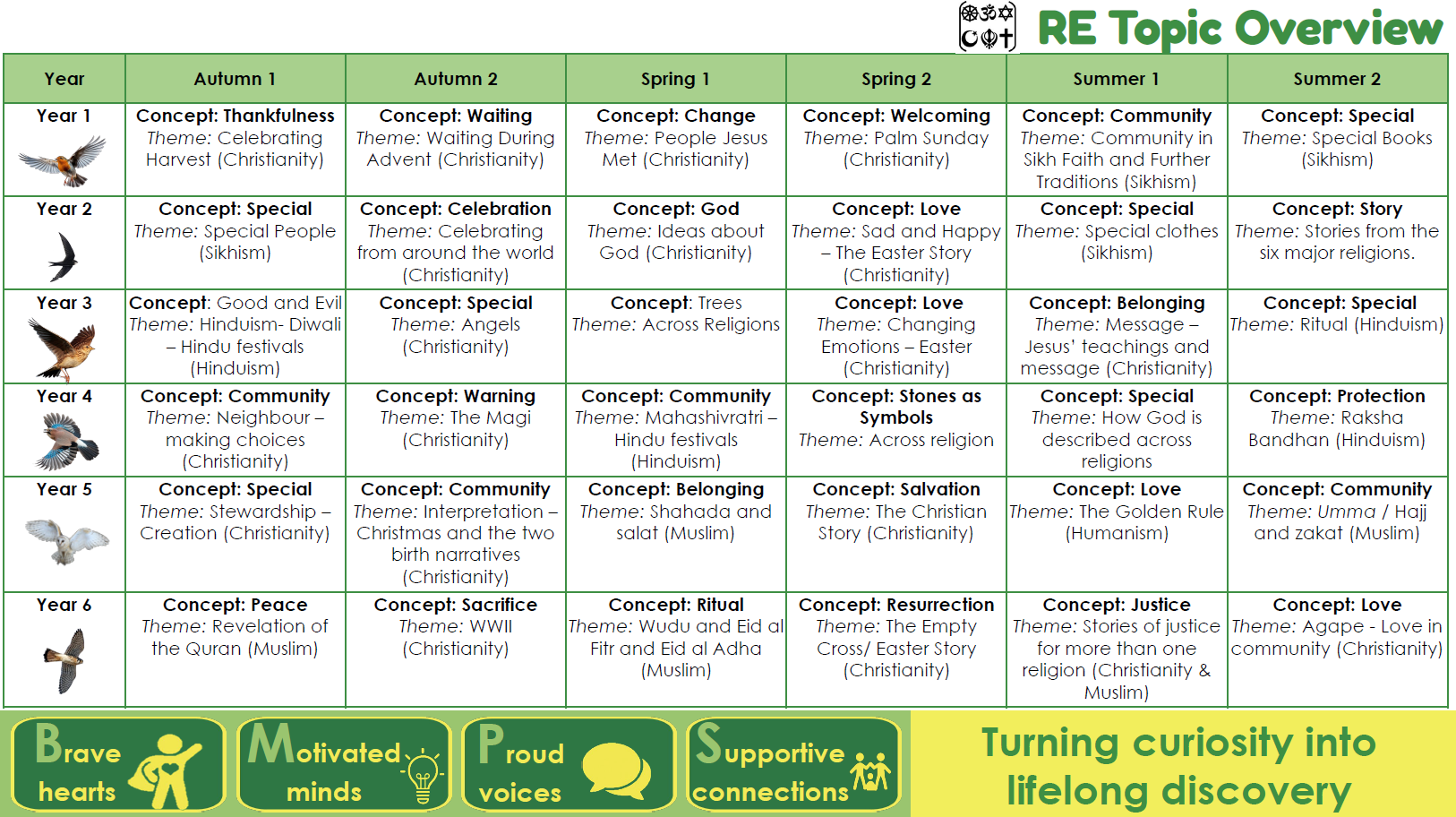
We think our curriculum should reflect our community, and we encourage everyone to bring their faith, values or experiences into our school. We believe a curriculum that reflects the community our children live in is something that should be inclusive for all. Therefore, during their time at Bitterne Manor Primary School, the children study 4 world religions and learn about non-religious world views:
- Christianity (main religion – taught in years R - 6)
- Sikhism (taught in years R, 1, 2)
- Hinduism (taught in years 3, 4)
- Islam (taught in years 5, 6)
- Humanism (taught in years 5, 6)
 Curriculum Implementation:
The minimum number of hours that pupils will spend on R.E. increases as they move through the school. In Year R and KS1, the expectation is 36 hours a year, whereas in KS2 this increases to 45 hours a year.
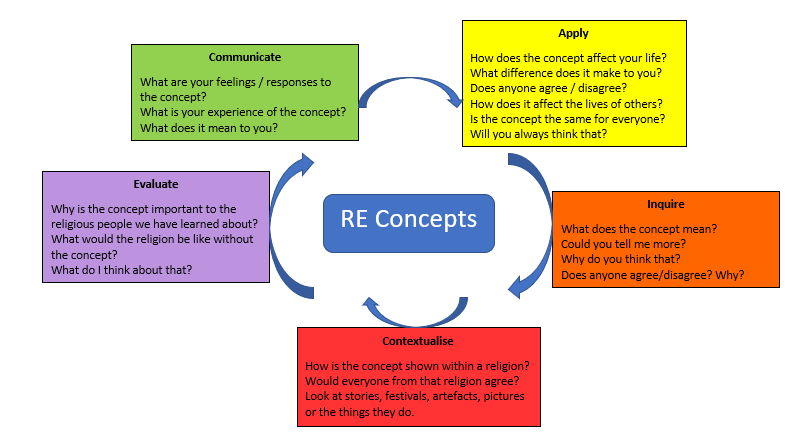
R.E. is taught through concepts at Bitterne Manor Primary School using a cycle of enquiry. The cycle starts at either Enquire or Communicate.
 Curriculum Impact
The RE curriculum at Bitterne Manor Primary School, delivered using the Living Difference scheme, has a clear impact on pupils’ knowledge, understanding, and personal development. Through carefully sequenced units, pupils gain knowledge of a range of religions and worldviews while developing the skills to reflect, question, and discuss ideas thoughtfully.
Pupils make progress in understanding core religious beliefs, practices, and values, and are able to apply these in meaningful contexts. They develop empathy, respect, and critical thinking, exploring the relevance of religion in their own lives and in the wider world.
By the end of each key stage, pupils demonstrate increased confidence in discussing and expressing their own ideas, a deeper awareness of diversity, and the ability to engage respectfully with different beliefs. The curriculum fosters spiritual, moral, social, and cultural development, preparing pupils to be thoughtful, reflective, and responsible members of society.
Collective Worship:
Collective Worship is an important part of our school community. Assemblies are organised as follows:
- Monday: Whole School assembly
- Tuesday: Whole School assembly
- Wednesday: KS1 Celebration Assembly / KS2 Class Assembly. Parents of children in the 'Golden Book' are invited to attend.
- Thursday: KS2 Celebration Assembly / KS1 Class Assembly. Parents of children in the 'Golden Book' are invited to attend.
- Friday: Whole School Celebration – Recognition of children with the highest amount og Dojo points and recognition of children being kind that week and performing well on TTRS / Numbots